On October 15 at 10:15 AM, radio amateurs from many countries around the world, including the Shuswap Amateur Radio Club (SARC), participated in the annual ShakeOut earthquake preparedness drill. Organized by the British Columbia Earthquake Alliance (BCEA), The Great British Columbia ShakeOut provides an annual opportunity for individuals, communities, schools, and organizations to practice essential earthquake safety measures such as “Drop, Cover, and Hold On,” while allowing emergency communications groups to test their radio networks.
What to Do (and What NOT to Do) During an Earthquake
DO (“Drop, Cover, and Hold On”):
-
DROP onto your hands and knees immediately to prevent being knocked over.
-
COVER your head and neck under a sturdy table or desk. If no shelter is nearby, crawl next to an interior wall away from windows.
-
HOLD ON to your shelter until the shaking stops.
DON’T:
-
Do NOT run outside or to other rooms during the shaking, as falling debris and glass pose the greatest danger.
-
Do NOT stand in a doorway—modern doorways are no stronger than other parts of a building and do not protect you from falling objects.
-
Do NOT use elevators during or immediately after the earthquake.
Field Communication & Radio Test
During this exercise, Peter (VE7PAE) actively participated using an HF transceiver to send emergency reports via HF digital transmissions.
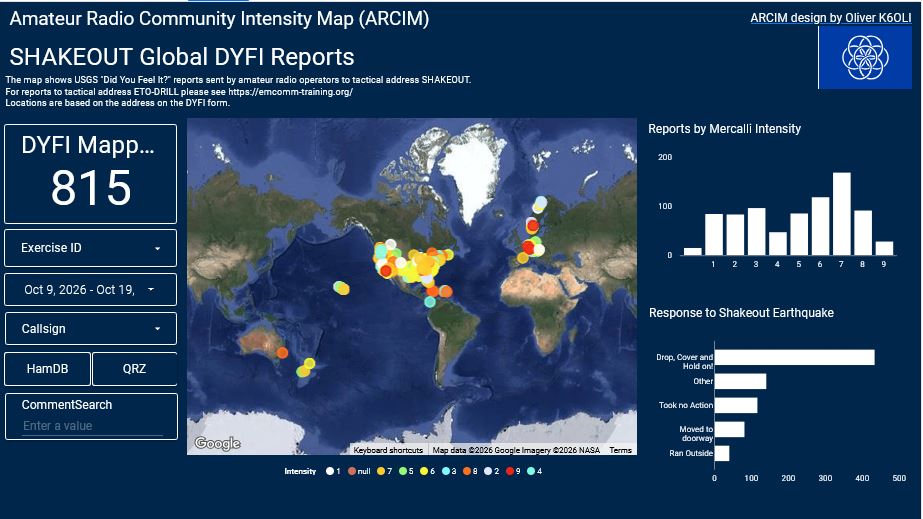
The emergency exercise included submitting a USGS DYFI (“Did You Feel It?”) report—a standardized survey created by the United States Geological Survey to collect localized, subjective field observations on earthquake intensity and shaking severity. Data from these reports is mapped onto the Amateur Radio Community Intensity Map (ARCIM), providing emergency managers and radio operators with a clear, visual overview of shaking effects across affected regions. Key data points entered into the DYFI form include:
Key data points entered into the DYFI form include:
-
Observer Location & Time: Exact geographic coordinates or street address and time of the observation.
-
Situation at the Time: Operator’s location (indoors, outdoors, in a vehicle) and activity when shaking occurred.
-
Shaking Experience & Motion: Subjective felt intensity (e.g., weak, strong, violent) and type of motion (e.g., subtle swaying, sharp jolts).
-
Observed Effects: Movement of indoor objects (e.g., rattling dishes, falling items) and structural reactions (e.g., creaking walls, wall cracks).
-
Personal Response: Action taken during the event (e.g., dropped and covered, ran outside, no action).
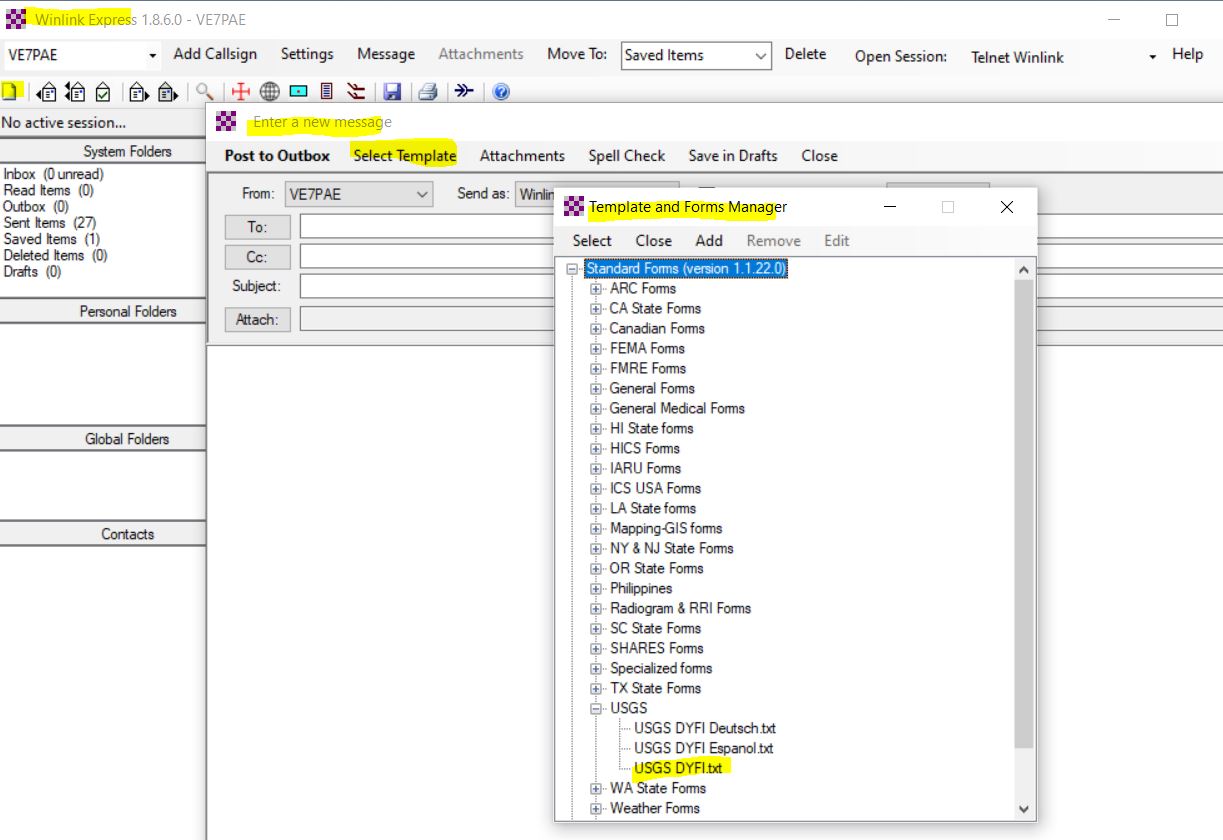
Using Winlink Express over VARA HF, the following reports were successfully transmitted over high-frequency radio:
-
USGS DYFI (Did You Feel It?) Form
-
2026 Amateur Radio ShakeOut Preparedness Survey
-
2026 Amateur Radio ShakeOut Quiz
This test demonstrated reliable digital messaging during emergency scenarios. The main advantage of Winlink and VARA HF is that even if local power and internet completely fail, operators can still send error-free data over long distances. Messages go directly to other radio stations or to gateways outside the affected area that still have internet, ensuring critical information reaches emergency officials.
Resources & Additional Information
For more details on earthquake readiness, exercise guidelines, and helpful planning tools, explore the links below:
-
General Earthquake Preparedness: Explore up-to-date guidance and safety tips to ensure you and your home are ready before a quake strikes:https://www.shakeoutbc.ca/media-resources/general-preparedness-information/
-
ShakeOutBC: https://www.shakeoutbc.ca/
-
LAXNORTHEAST ShakeOut Exercise Page: https://www.laxnortheast.org/exercises/shakeout
Gallery
-
Amateur Radio Community Intensity Map (ARCIM)
-
Winlink Express selection of USGS DYFI forms